Companies spend millions governing digital access. They invest in sophisticated Identity and Access Management and Identity Governance environments to control applications, accounts, privileges, cloud platforms and, increasingly, machines. They know who someone is, what role that person has, what access should be allowed, who needs to approve it and what should happen when that person leaves the organization.
Yet the moment access shifts from the digital world to the physical world, that same discipline often disappears. Someone hands a contractor a key, and suddenly a carefully governed access model becomes remarkably old-fashioned.
The key isn’t expensive
A physical key itself is rarely a major business expense, but the process surrounding it can be. It needs to be issued, registered, assigned to the right person, connected to the right permissions and updated when circumstances change. Someone must manage contractors, respond when a key is lost, revoke access when it is no longer needed and, eventually, answer the question every auditor or security officer will ask: “Can you prove who had access to this location six months ago?”
That is usually when the spreadsheets appear. The real cost of physical access is therefore not necessarily the hardware itself, but the administration surrounding it. Multiply that administration across thousands of employees, contractors, keys, cylinders and locations, and something as apparently simple as key management becomes a substantial operational process.
Governance sounds expensive
Governance has an image problem. Mention it, and people often think about policies, controls, auditors and additional administrative work. Good governance should achieve exactly the opposite: it should create certainty.
It should make it clear who has access, why that access was granted, who approved it, whether it is still necessary, when it should expire, whether it can be revoked immediately and whether the organization can prove what happened. If answering those questions requires manual investigation, the organization does not really have governance. It has administration.
NIS2 and CER are changing the discussion
This becomes increasingly important for critical infrastructure. NIS2 and the Critical Entities Resilience Directive are pushing organizations toward stronger cybersecurity and resilience controls, and resilience does not stop at the firewall. Transformer stations, water installations, telecom sites, railway cabinets and datacenters are all physical assets. The person opening the door to those assets represents a security decision.
That leads to a simple principle:
Every access decision to a Critical Infrastructure Asset should be an Identity Decision
We already know how to solve this
Interestingly, this is not a new problem. Much of it was solved years ago in IT, where Identity Governance platforms such as SailPoint already manage identities, roles, policies, approvals, certifications and lifecycle events. When someone joins an organization, access can be provisioned; when they change roles, permissions can be adjusted; and when they leave, access can be revoked.
This raises an obvious question: why create an entirely separate governance process for physical access? If the same identity decision can determine whether someone may access an application, it should also be able to determine whether that person may open a critical infrastructure location. That is where Key2XS comes in.
Connecting Identity Governance to the physical world
Key2XS connects Identity and Access Management and Identity Governance environments with electronic locking and key systems, allowing physical access to become part of the existing identity lifecycle. Instead of separately administering thousands of physical permissions, organizations can use their existing identity information and governance processes as the basis for physical access decisions.
In that model, the identity determines the role, the role determines the policy, and the policy determines the appropriate physical access. The electronic key system then executes that decision. When the identity or role changes, physical access can change with it.
Now the economics change
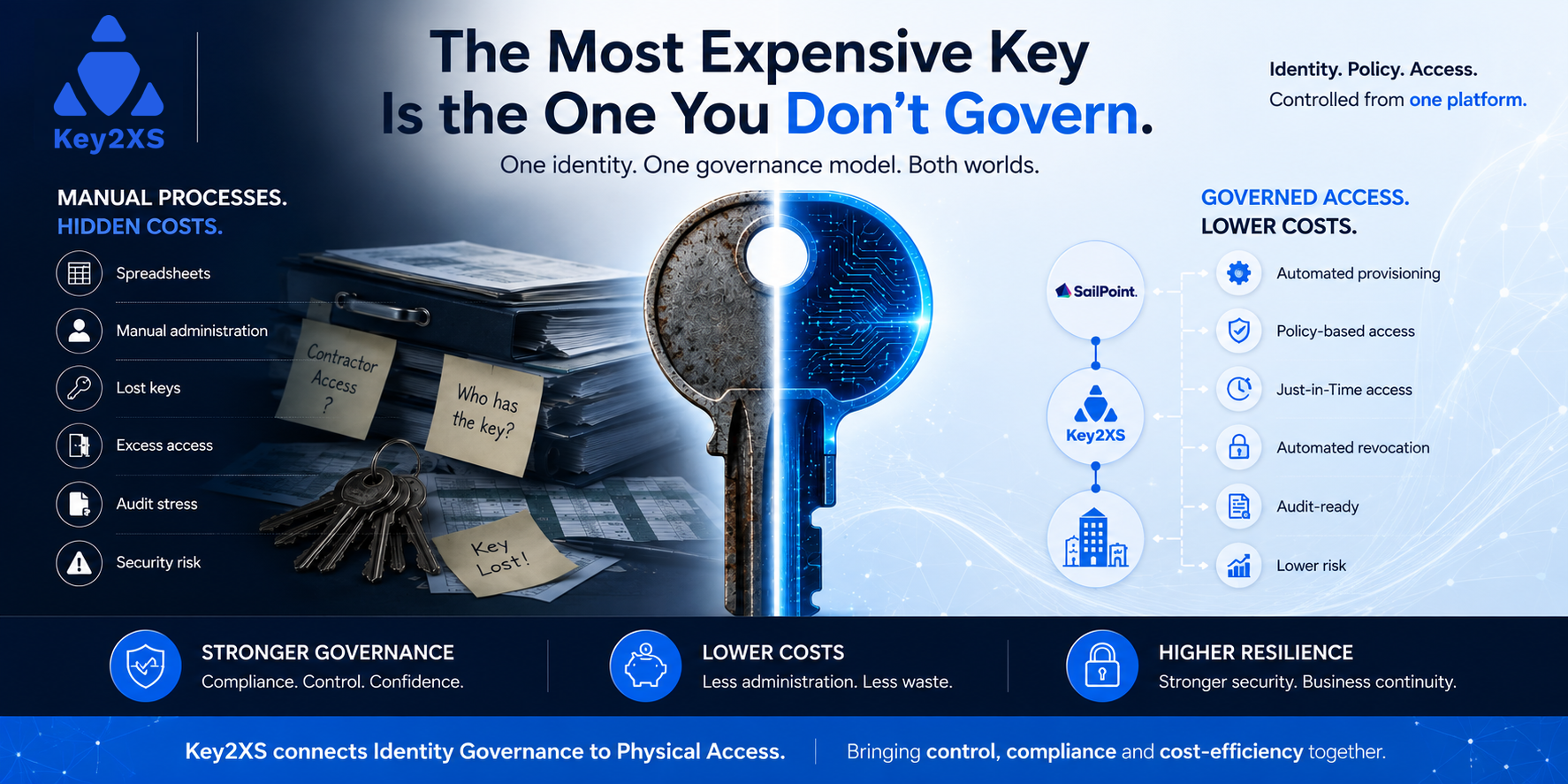
This is where governance and cost stop being opposing objectives. Automated provisioning reduces administration, automated revocation reduces both administration and risk, policy-based access reduces unnecessary permissions and Just-in-Time access reduces standing privileges. Centralized governance also prevents fragmented processes, while automated audit trails reduce the effort required for compliance.
By integrating with existing Identity Governance infrastructure, organizations avoid creating yet another isolated administration environment. In other words, better governance can make physical access cheaper to operate.
The spreadsheet is the warning sign
There is a useful test. Ask an organization, “Who can currently access this critical physical asset?” If the answer requires calling several departments, opening multiple management systems and comparing spreadsheets, there is a governance problem.
That does not necessarily mean the organization is doing something wrong. It often means physical access evolved separately from digital identity. That separation, however, is becoming increasingly difficult to justify.
One person. One identity.
An employee does not have a digital identity and a physical identity. A contractor does not become a different person when they leave their laptop and walk toward a transformer station. There is one identity, and there should therefore be one governance principle determining what that identity is allowed to access: applications, data, cloud infrastructure, privileged systems and physical assets.
From key management to Physical Access Governance
The transition therefore goes much further than replacing mechanical keys with electronic ones. Digitizing the lock is only the first step; the bigger transformation is connecting that lock to enterprise governance.
Traditional key management asks, “Who has which key?” Physical Access Governance asks a broader and more strategic question: “Who should have access to which asset, under which conditions, based on which policy, approved by whom and for how long?” That is a very different question, and it is where regulation, security and economics start reinforcing each other.
Better governance enables automation, automation reduces operational cost, better access information reduces risk and faster revocation increases resilience. At the same time, stronger auditability reduces compliance effort, while lower operational complexity contributes to long-term enterprise value.
The physical world is finally catching up
For decades, physical access has been one of the forgotten domains of enterprise identity. That is changing. Electronic locking technology has matured, Identity Governance has matured, regulation is increasing the urgency, and organizations are under continuous pressure to reduce operational costs. The pieces are now coming together.
The result is a relatively simple business equation:
Better Governance → More Automation → Lower Cost → Lower Risk → Greater Resilience
Perhaps governance was never the expensive part. Perhaps the expensive part was operating without it.